

Don't Hug Me, I'm Scared to Keep Watching
How DHMIS explores the horrifying truths of children's media

Modern day children’s entertainment is, to an extent, just slop pumped out to make a quick buck.
That isn’t to say all of it is bad — there are absolute standouts like Bluey. But for every good show that genuinely teaches kids something, there’s a hundred more designed to rot their little brains for ad revenue.
In the age of YouTube, this issue has only gotten worse. YouTube Kids is a curse: an endless feed of god-awful nursery rhymes, uncanny CGI babies, and content that feels like it was once a product of a Delta-8 trip. Gone are the days of Sesame Street reigning supreme, teaching children about the importance of their behavior while also dabbling in the ABCs.
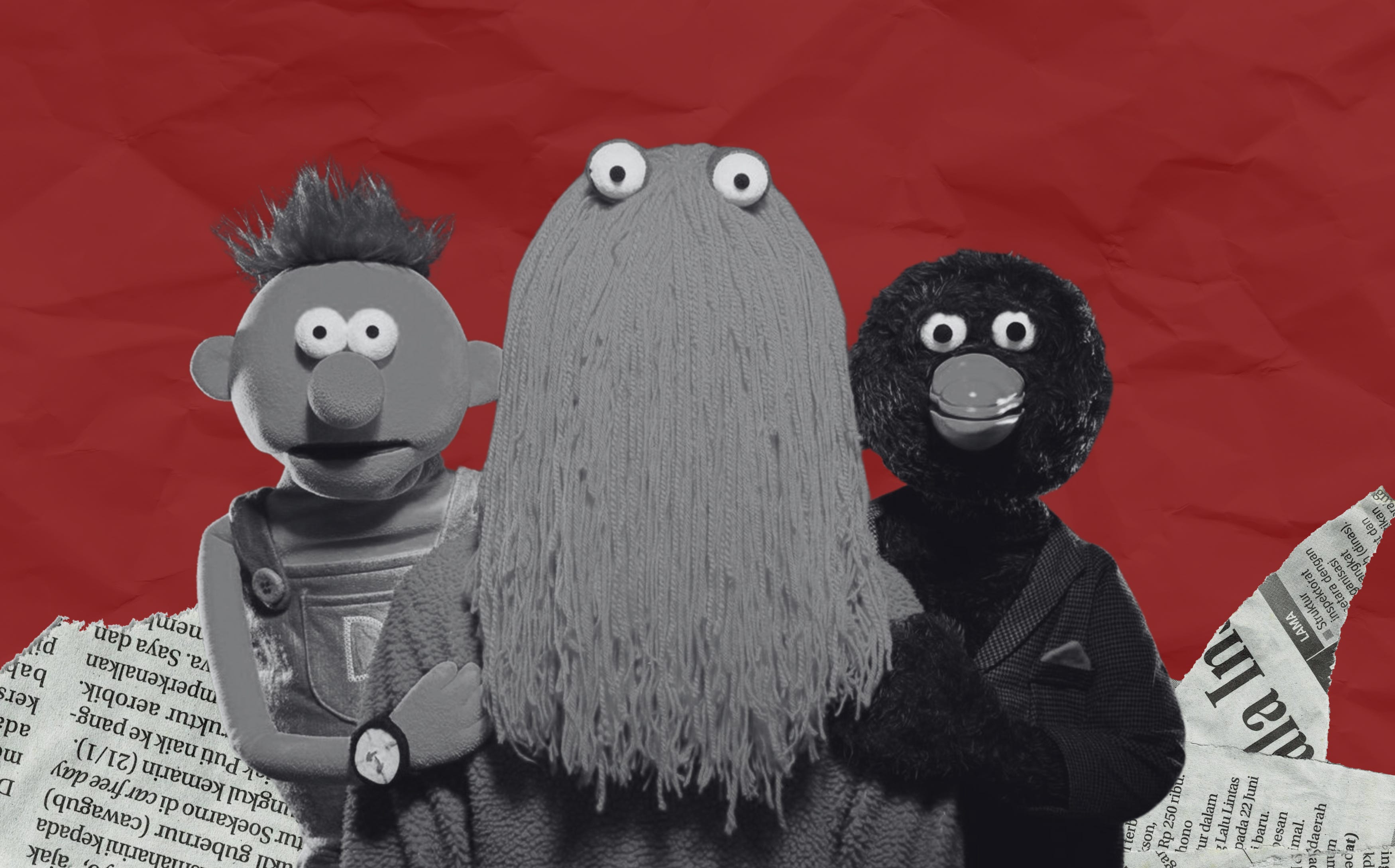
Enter 2011, when the first episode of Don’t Hug Me I’m Scared was uploaded on YouTube. Surreal in nature, the video consisted of three puppet characters reminiscent of a classic Jim Henson production: bright primary colors, preschool vibes, the whole package.
However, DHMIS was far from just another children program—in fact, it was quite the opposite, criticizing the very thing it replicated.

Selling Junk to Kids
Episode 5 of Don’t Hug Me I’m Scared explored the serious issues of advertising on children's programs. Whether it’s in the show itself or during commercials, these ads play a dangerous role for children’s health.
Throughout the episode, the “healthy” food band contradicts themselves as they try to explain to Yellow Guy and Duck Guy about what foods they “should” be consuming. White sauce is good for you, but then it’s not. This food makes your teeth gray, but it’s also good for your gut.
It’s a confusing song that serves no real purpose for the audience, leaving us with no actual lesson to learn from.
At one point, the episode shows us what looks to be its own version of the food pyramid:
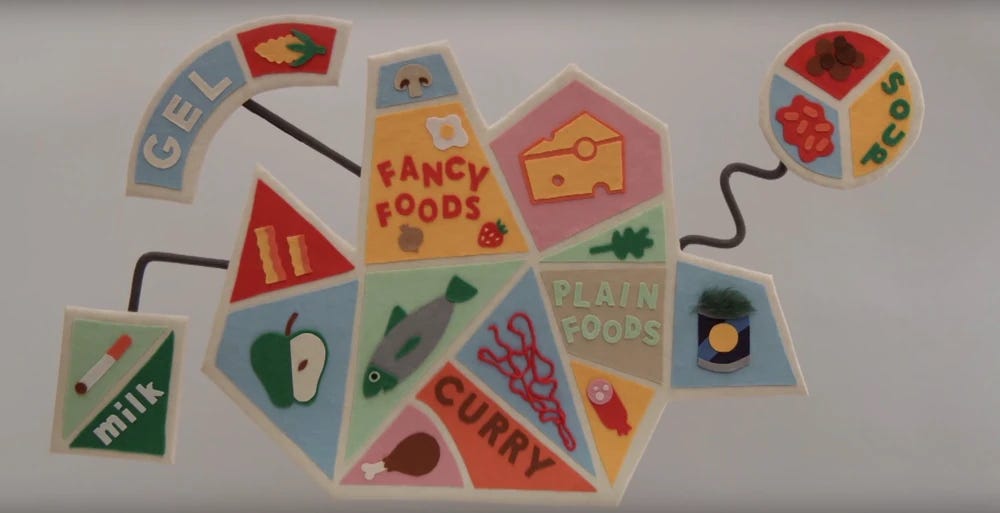
It’s not quite a pyramid, or any shape at all really, and most of the food on it certainly isn’t healthy. Curry, fried chicken, French fries, cigarettes… it’s all on there, yet none of it is exactly nutritious.
The real food pyramid, at least the one that most of us grew up with in the United States, was created in 1992 by the USDA. The base and foundation of every meal was refined grains, such as cereals, breads, and pasta. These foods aren’t “bad” inherently, but it is strange that a supposedly scientific health guide prioritized refined grains over more nutritious whole grains like oats, brown rice, and barley.
But perhaps the most concerning issue came with food lobbying (which is still very much an issue today). Grain and dairy products weren’t part of the pyramid out of science, but rather from the food industry buying their way in.
You can see how this confused adults, never mind children who were fed pizza and cheeseburgers every day for school lunch.
However, I think this episode of DHMIS is focusing primarily on how the food industry so aggressively targets children, especially in ultra processed products.
Like… do you remember when Disney and McDonald’s had a partnership for over 10 years? You know, the one where you could buy McDonald’s fries at Animal Kingdom?
Or maybe we can look at how every sugary cereal brand is covered in bright colors… or how they used to have toys inside… or how they have cartoon mascots… or maybe even how the major cereal brands still try to claim that their products are part of a healthy breakfast.
Not enough for you? Remember when Danimals commercials would come on featuring the Sprouse twins on Disney Channel? Remember how we all wanted to win the Danimals sweepstakes to meet them?
I guess there’s also the various fast-food commercials focusing on toys.
My favorite, though, has to be the old school M&M’s campaigns. Seriously… think about it. The plushies, the merch, the old PC games that I used to be hooked on.
These were all things targeted toward children, despite the fact that they’re all extremely unhealthy and not at all good for a growing kid. I mean, seriously… I shouldn’t have been eating Lunchables… or Chef Boyardee… but damn, did them food scientists do a good job at making them taste great.
By the end of the DHMIS episode, Yellow Guy is left alone in the kitchen. He ate his friend, Duck Guy. But he’s also in the dark, gluttonous as he stares at the empty tin cans.
This ending shot is the perfect allegory for everything we’re talking about here: children are left in the dark about the food they consume, oftentimes unaware of how bad their snacks are.
Red-40 impacts behavior. Excess sugar leads to crashes. Saturated fats make you sluggish. School cafeteria lunches practically engineer disconnection and lack of focus.
So, when Yellow Guy is sitting there with green feathers hanging out his mouth, it’s not for shock value—it’s the end result of kids being raised on great (albeit unethical) marketing instead of real nutrition. DHMIS forces the audience to look deeper into ads and peel back what they really are…
They aren’t there to feed your kids. They’re there to make your kids into future customers… ones sick enough to buy the miracle cures the same companies are to sell them.
Creativity is the Enemy
Children entertainment often focuses on teaching kids how to embrace their creativity.
Shows like Blue’s Clues and Mickey Mouse Clubhouse focus on developing children’s critical thinking skills through imagination, problem solving with colors, shapes, and pretend play. But even with these colorful examples, there’s still an undercurrent pulling children into conformity.
Oftentimes, this is disguised as “following the rules” or doing something “the right way” … even in these bright worlds supposedly fueled by imagination, the message to stay in line still lingers in the background.
In the first episode of DHMIS, this contradicting issue is explored through Sketchbook, explaining to the group what creativity means. On the surface, this all seems well and good, but as the lesson drags on, we see that Sketchbook doesn’t actually want the three to learn true creativity.
As Yellow Guy, the puppet meant to obviously represent a child, keeps trying to express himself, Sketchbook keeps dismissing his attempts. When he paints a clown, she pours oil over it. When he says his favorite color is green, she tells him that green isn’t a creative color.
Of course, this was the most viral episode of all, and most of us remember the outrageous ending with the three main characters cutting into a cake made of organs. The end shows them all visibly shaken up, with Sketchbook telling them to never get creative again.
The message is clear: you created something strange, unsettling, or outside the norm—so you’re no longer allowed to express yourself.
We see this in real life too, especially in schools when art programs are being cut in favor of budgeting for sports and testing. Kids need to stay in line and be marketable, not embrace their creativity and express their true feelings.
This is a policing of creativity, rejecting the very freedom it’s meant to give you.
Spotlight on Children
DHMIS is a series that focuses on the dangers of children’s television. Clearly, there’s always going to be exceptions to this, but DHMIS dives into the obvious issues seen within modern preschool programming.
One of the strongest examples of this is in episode 3, simply titled “Love.”
In this episode, Yellow Guy is recruited by a strange bee character to join his communion. The episode is meant to explore the value of love, both platonically and romantically, but when Yellow Guy begins to ask questions, he is immediately shut down.
In fact, he’s forced into the “communion,” which is later revealed to be a cult.
Yellow Guy becomes a stand-in for every child who is taken advantage of, vulnerable and lonely. Someone who accepts the lesson even if it feels wrong.
Instead of being encouraged to ask questions, he’s told to stay silent and simply accept what he’s told… because here, love means compliance.
And isn’t this what we see in our schools? Kids barely learning fragments of history, watered down and delivered through rose-colored glasses, being taught that questioning the narrative is somehow disrespectful.
But it isn’t just the schools, this goes back to the children’s programming as well. TV shows wrapped in bright colors and cute mascots, preaching about the importance of whatever message they’re teaching that week.
I know it sounds silly, but for me that program is Caillou. Even as a kid I hated this show. While now it’s universally called out for setting an awful example for kids, back then it wasn’t as talked about.
Caillou was just like “any other kid,” except he cried about not getting his way 24/7, acted out all the time, and was a total jerkwad to his baby sister. That wouldn’t be an issue if the show showcased why that was bad… except Caillou never faced any consequences for his own actions. I don’t even remember if he got a “talking to” or a time out.
It disregarded teaching kids about emotional regulation and boundaries, thus creating a generation of potentially dangerous adults.
But maybe that’s too silly… you know what’s not? Thomas the Tank Engine.
Thomas & Friends quite literally is a dystopian hell… but maybe I’ll save that for another time.
What I’m getting at here is that children’s tv shows sometimes masquerade as innocent, but underneath the cutesy colors is something a lot darker.
So, what does Don’t Hug Me I’m Scared all mean?
Once you peel back the layers of shock value and horror, it presents a scathing critique on the modern landscape of children’s media. It is about corruption, money, and manipulation… just like most things in this world.
On the surface, it may seem like just another attempt to make children’s media scary—like many creepypastas back in the day—but it’s really an important tool in showcasing the reality of the situation. DHMIS isn’t a parody, it’s an exposé.
Kids are shaped by what they see, and with their media subtly molding them into obedient little consumers… we’re in desperate need of more stuff like DHMIS to lead the way.
The puppets aren’t the scary part about DHMIS… the people behind the cameras for children’s TV shows are.
P.S. if you liked this one, you’ll probably like my issues about Amanda the Adventurer or Horror That Isn’t Horror.