

Hidden Rooms
On the lives we never lived

The Archive’s office has a saying, from which we are certain is from The Operator, as the handwritten note has been pinned to the breakroom’s corkboard since the company has been operating.
The paper is beginning to yellow at the corners, yet the ink that stains the page refuses to fade despite the many years of facing the harsh fluorescent lights above it.
On this paper reads: “We explore other people’s pasts every day. Remember to live in your present.”
While easy in theory, it is often the most difficult for us to remember the simplicity of the present. It’s not that we are always thinking of our past, but sometimes our future, and other times nothing at all.
Instead of taking time to see the abundance that lends itself to us daily, we look to distraction. We would much rather be distracted than face reality, wasting our lives away in the endless abyss of whatever vice of our choosing.
Our minds cling onto our past the most in this case. Why didn’t we take that risk? Why didn’t we ask them on a date? Why didn’t we go for that job? Why, why, why, and why is all we ask over and over again, yet we get no answer.
We keep repeating the same questions, the same interactions, and the same simulations. Yet, we are no closer to clarity than we were before.
And so, because we cannot find clarity in the past, we begin to create our own answers. We begin to think in what ifs instead of whys.
What if I had asked about that job opening two years ago, would I be wealthier and more successful now? What if I had gone on that trip, would I have received an opportunity to meet someone?
And then, we begin to daydream and fantasize. I’d be married by now, I’d be rich by now, I’d be a business owner by now, etc.
Marcus Aurelius once said: “If you are distressed by anything external, the pain is not due to the thing itself, but to your estimate of it; and this you have the power to revoke at any moment.”
We should not let the things that didn’t happen rule our minds. And so, that is where The Archive brings in the peculiar case of Clark [REDACTED].
The man who owned Cap’n Clark’s Ottoman Empire—and found the secrets no human was ever meant to discover.

PART I: BLUEPRINTS
The 90s was the era of rebellion.
Gen X proudly stood against the status quo in an effort to make a statement to the Boomers before them, though perhaps their greatest fault was the isolating feeling of unwavering defeat.
It was not that they didn’t want change—in fact, many tried hard to create some—but rather that the Boomers had held on so tightly to their authority.
From Gen X’s rebellion came irony, sarcasm, and the need to not look like you care too much. As Kurt Cobain once said: “I’d rather be dead than cool.”
Grunge, punk, and hip-hop filled the young people’s stereos. The slacker-generation finally felt heard.
But it was more than that. It was exactly the thing that Clark [REDACTED] was dealing with—a need to rebel against a system that he felt failed him.
From The Archive’s research, Clark was more than just a furniture store owner; he was a dreamer running on nightmares.
Our investigation into this case led us to collect therapy minutes, security footage, and declassified files from the Async Research Institute.
Clark’s therapist was Dr. Mary Kline, famed for her book The Window Within about escaping your inner thoughts and achieving through obstacles. It was, to put plainly, as generic as most self-help books were for the era.
From Dr. Kline’s notes, The Archive was able to piece together the following about Clark:
Clark was recently divorced from his ex-wife, Barbara.
Clark was living in his furniture store, as his ex-wife had kicked him out of the house.
Clark resented his ex-wife for “making” him pay for her schooling.
Clark wanted to be an architect.
Clark was an alcoholic.
Dr. Kline’s notes also painted a tragic picture for Clark: he was stuck in a life he never had.
One thing that stuck out to The Archive’s research team was the repetition of Clark’s inability to accept reality. He frequently would correct Dr. Kline, telling her he was an architect, just not in practice due to having to pay for his “lazy” wife.
And so, that is only the beginning of this case.
The prologue, if you will.
Dr. Kline’s last session with Clark noted how he seemed frantic. She wrote that he was suffering from delusions.
He had brought her a piece of paper with a floor plan detailing some miraculous hidden room in his store, though the plan itself didn’t make any sense. Clark said the following to Dr. Kline after she refused to feed into his erratic behavior, as found in her notes:
“Imagine describing a dog to someone who’s never seen one before and then asking them to draw it. They might get some things right, you know, but there is no way they would get everything right, you know? The devil is in the details.”
And yet, Clark’s delusions were never about being right or proving something to anyone. While true that he was enmeshed in a less-than-ideal situation, the reality is that Clark’s mind wasn’t as fractured as Dr. Kline believed.
As they say, you have to see it to believe it.
But then, The Archive must question Clark’s intentions going forward. While, yes, he distrusted his status in life, he was not a rebel.
He was not, in any sense, the stereotype of 90s attitude. Instead, he was the very thing that those young Gen Xers so desperately tried to stay away from. They couldn’t bear the idea of giving their lives away to the authority that ripped their dreams from them.
But Clark… well, Clark never had the ability to let go of his own idea of success—an idea that clashed with reality.
PART II: FRAMEWORK
Cap’n Clark’s Ottoman Empire was left abandoned following Clark’s own disappearance.
Inside, in the basement, was a wall with a rectangle traced out in tape. According to records, this was where the “place” Clark found was.
No, not the basement itself, but rather through one of its walls. There was no hidden apartment behind it, though. Clark’s journal instead detailed that the room could only be accessed by stepping into the exact spot he had traced on the wall.
A normal case would’ve ended here.
A man claims he found something extraordinary to his therapist and goes missing. That in itself is not that strange.
However, everything that surrounds this case immediately rules out any kind of normalcy.
It was not just Clark that went missing, but also his assistant manager, her boyfriend, and Dr. Kline herself.
For most, this case would be classified as cold and unsolved. For The Archive, it meant to keep digging.
As our research team investigated this case, they eventually found papers and articles surrounding the Async Research Institute, though most of the information for this institution led the team to dead ends.
Due to limited resources, The Operator was asked to step in for communication on obtaining any records from them. Luckily for our team, The Operator is very resourceful, and was able to hand over video evidence to our researchers.
Attached is an Async Research Field Report:
From what The Archive could gather, Async Research Institute (or A.R.I. for short) named this place the Backrooms. Our researchers scoured hours of footage. We have no conclusion on what this place is.
Neither did A.R.I. before they went bankrupt.
Instead of attempting to give answers to an impossible solution, we instead offer answers to what may have happened to Clark and the others involved in this case. After all, that we do have solid evidence for.
From what The Archive could gather, Clark became obsessed with the Backrooms, as evident from his last session with Dr. Kline. He visited the area over and over again until he felt he needed to bring back proof to his therapist.
He had to show he wasn’t crazy.
And so, he brought his assistant manager and her boyfriend along with him into the Backrooms to document it. From the videos collected by A.R.I., it seems this decision was due to the boyfriend owning the camcorder rather than Clark thinking they were competent pioneers for the expedition.
Attached is another video that was archived by A.R.I., in which Clark is behind the camera:
Dr. Kline went after Clark soon after in concern for his safety, eventually finding herself inside of the Backrooms as well.
Although The Archive would like to say differently, all persons involved in this case remain missing.
PART III: COLLAPSE
Chinese Philosopher Lao Tzu argued that we must let go of our past in order to move on with our true destiny. As stated: “When I let go of what I am, I become what I might be. When I let go of what I have, I receive what I need.”
The Archive must bring this up, because the basic philosophy of letting go is a core theme in Clark’s case. Not because he eventually learned how to breathe out, but rather because he insisted on holding his breath to suffocation.
Clark was attracted to the Backrooms not out of curiosity but rather out of comfort. The endless nature of what the Backrooms is didn’t just fascinate Clark—it consumed him.
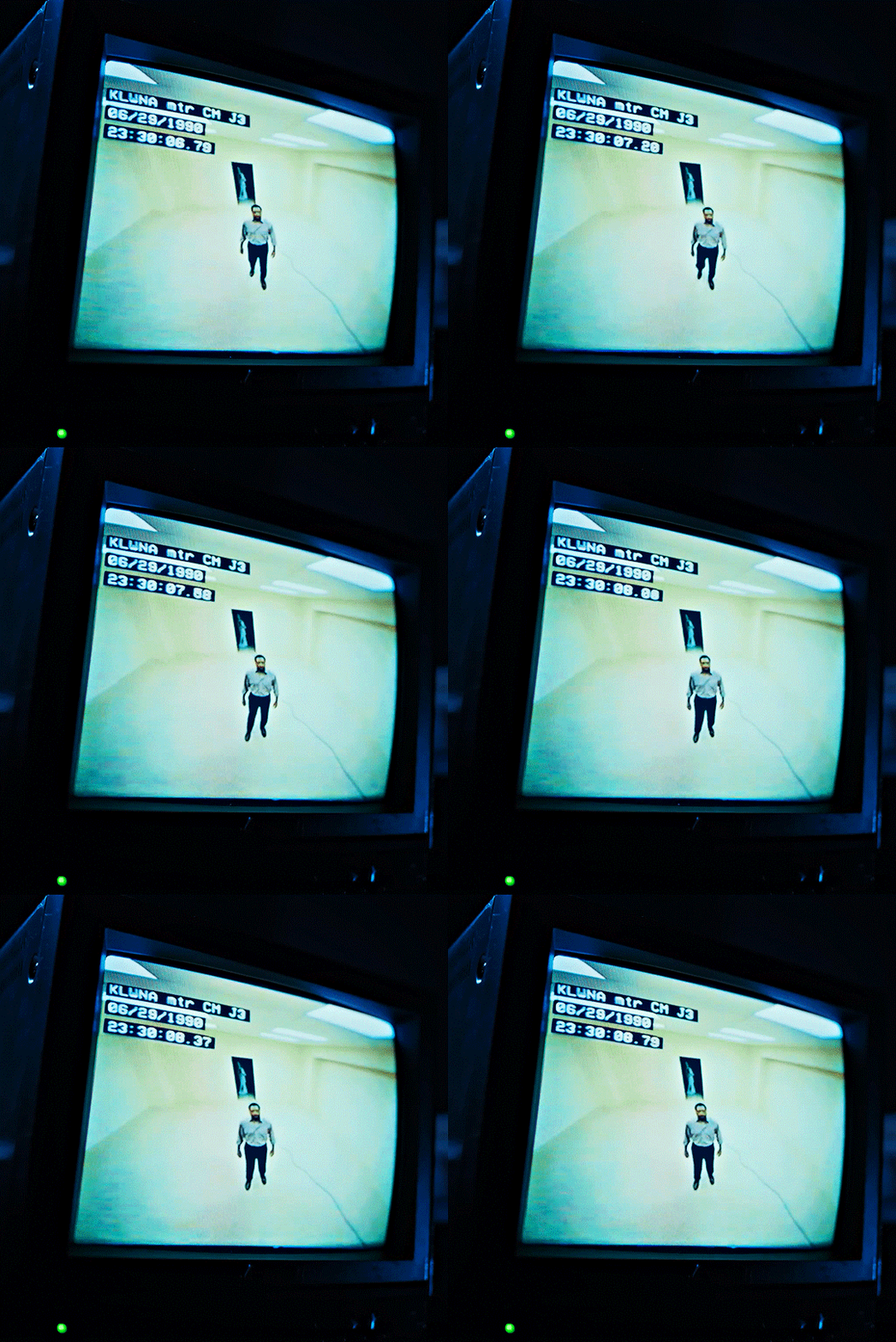
It acted as a manifestation of his inner turmoil, difficult to navigate not by design but by chance. The Backrooms is not man-made. In fact, there is no origin; we have no idea where it came from, how it got here, or why it is here. Yet, the vast maze of its bowels feels familiar because it feeds off our memories.
True, the A.R.I. never actually discovered what the Backrooms actually is. However, the research they gathered at least gives The Archive basic speculation into its creation.
It is not built by architects, it is built by human memories—that is why the rooms slant into mouse holes, why hallways stretch to nothing, and why doors lead to nowhere. These things are not created to make sense but rather to reflect how the human brain thinks back in abstract ideas rather than pristine pictures.
And so, that brings us back to Clark.
Clark was determined to be an architect. The Backrooms gave him the ability to finally be one.
He had endless possibilities to study, with countless designs to look after. To most, it would be a prison. To Clark, it was a muse.
The Archive theorizes that Clark’s time in the Backrooms only exacerbated his inability to let go of what he was never able to achieve. Despite feeling so close to the life he imagined, he never actually reached it.
He was instead bombarded with memories of the life he never had.
We can only come to this conclusion due to the A.R.I.’s security footage found in the Backrooms. Below is a snippet of a transcript from a conversation between Clark and Dr. Kline:
Clark: ... I don’t think I want to change.
Mary: Then don’t.
Clark: I like it in here. For the first time in a long time, I feel like I’m... Like I’m right where I’m supposed to be.
The truth is, Clark would’ve wound up lost even if he had never discovered the secret Backrooms.
He was already too caught up in the life that never was.
He lived inside of a liminal space his entire life.
But… that’s just how we’re wired, isn’t it?
Conclusion
Dr. Mary Kline gave the world The Window Within. Hidden between its cliché self-help jargon is a snippet that The Archive wishes to share with our readers:
We all have our loops. Our habits. Behaviors that keep us walking in circles. Reaching for the same solutions over and over again. Thinking each time will take you somewhere new, but they don't. And still, it's the neural pathway of least resistance. A path you made. It's the one that kept you safe when you were a child. You learned to push people away before they could hurt you. And now, as an adult, you're still stuck right where you started. Alone.
Loops.
It was the loop that ultimately led to Clark’s case. It was the self-pity, the victimizing, the feeling of invalidation for a life he felt he deserved but didn’t have.
Clark became one with the Backrooms because it reflected exactly who he was inside, unwilling to let go of the endless excuses for why he had to keep living in the past.
You see, the Backrooms cannot offer one any presence. There is no idea of being present in a never-ending maze. You cannot find abundance in a place that is too overly abundant. It is an oxymoron of the soul.
And so, we at The Archive leave you with only one thing: do not allow yourself to slip into the Backrooms like Clark.
There is no relief there.
The only way to feel better is to focus on your breathing. To breathe in, to breathe out. To be present in your body, your mind, your soul.
Take a look around you.
There is a lot more to see here than in the hidden rooms of our minds.
If you believe in The Archive’s work, you can support further investigations here.