

It's the End of the World as We Know It
The horror of apocalyptic movies isn't the world exploding after all

Apocalyptic stories are nothing new. Since we humans started to create stories from our creative little brains, we’ve came up with different ideas surrounding the end of the world. However, it wasn’t until the invention of moving pictures that we were able to visually see the concept.
In 1916, The End of the World was released. From what I can tell, this film is credited as the very first apocalypse film. Despite being silent, the film gave audiences a glimpse at what a potential world-ending event could look like:
“As a spectacle this production scores emphatically, and the impression left by the overwhelming calamity depicted in reels five and six is made stronger by reason of the preparation in earlier scenes...” - Moving Picture World
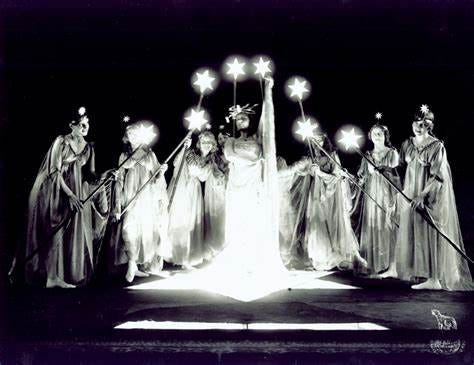
What made this film so terrifying for audiences at the time wasn’t necessarily the story itself, but the fact it was released during WW1. In a time of unrest and paranoia, an apocalyptic movie only heightened the fear of what many people were already experiencing. This was the war of trenches and new technological advancements, and with so much unknown surrounding the war… the idea of the end wasn’t too far-fetched.
Nowadays, movies about the world ending aren’t always as effective. With so many different versions of how we succumb to the ultimate end—asteroids, floods, freezes—it seems that we have become desensitized to the genre.
Perhaps it’s because some of us feel invincible, that these things would never happen while we’re alive on this planet. Perhaps it’s because the real horrors of the world are scarier than the idea of an asteroid taking us all out. Perhaps it’s because we know we’re more likely to kill each other than to be killed by nature.
But maybe we shouldn’t so be quick to dismiss these films in modern day… because the real horrors of the apocalypse don’t come from the destruction of life, but rather the erasure of what makes life worth living.

The Erasure of Nature
A walk outside, even just for five minutes, can brighten your entire day.
The vitamin D, the fresh air, the beautiful sights and sounds from the world around you…
I’ve been enjoying visiting different state parks and exploring nature that way. The sun bounces off the leaves just right, the animals are at peace, and everything always just feels… calm. Whenever you stop to actually appreciate what the earth has to offer, you realize just how lucky you are to be here.
Even the architecture of our cities is to be appreciated. To see the historical sights, acting as living museums, makes you think about how crazy it is that those structures are still standing so many years later. Those buildings and monuments have survived nature longer than us.
When you think apocalyptic movies, you often forget the most tragic part of the destruction that comes from them: the end of nature.
Our animals, our flowers, our years of history—all wiped out with just one event.
In a film like The Day After Tomorrow, nature is forced to transform because of the actions of humans. Climate change begins, though rather quickly, as if the earth is trying to get rid of a disease.
Different countries are struck with various natural disasters: hurricanes, hailstorms, tornadoes, blizzards, etc. Superstorms attack the world with heavy force, killing populations left and right.
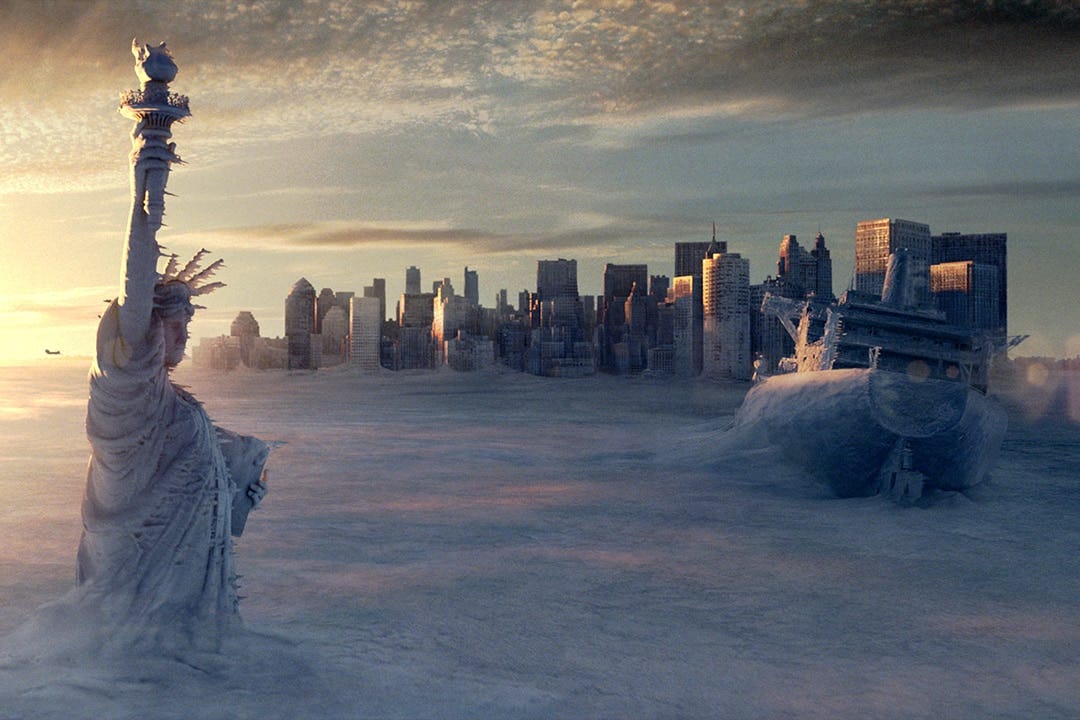
At the same time, these weather events transform the landscapes. New York City goes from being one of the most recognizable city skylines to being underwater and frozen over all at once. Hollywood is destroyed by tornadoes. Tsunamis wash away whatever cities are in their path.
While the humans are killed, so are the beautiful animals and plants. The only difference is that nature can bounce back, as the end of the movie shows astronauts in space remarking how clear the earth’s air looked.
Similarly, in 2012, we also see natural disasters take over the world and kill billions. This film was created in 2009, back when people misunderstood what the Mayan calendar meant. The Mayan calendar ended with 2012 not because it was the end of time, but rather a change in the cycles of time. But by 2009, people were convinced that the conspiracy theory of the world ending on December 21, 2012 was fact.
Here, we see more destruction of our planet than we do in The Day After Tomorrow. In 2012, the entire Pacific Coast suffers first, as a 10.9-magnitude earthquake rocks along the San Adreas Fault, tearing apart cities and completely disrupting the landscape. From there, Yellowstone Caldera erupts, earth’s crust shifts, and a megatsunami floods the world.
By the end of the film, the planet is bare. It’s completely changed, with the animals and plants destroyed. Really, the most terrifying aspect of 2012 comes from the fact that we see our home destroyed… because we’re reminded that it doesn’t just belong to us.
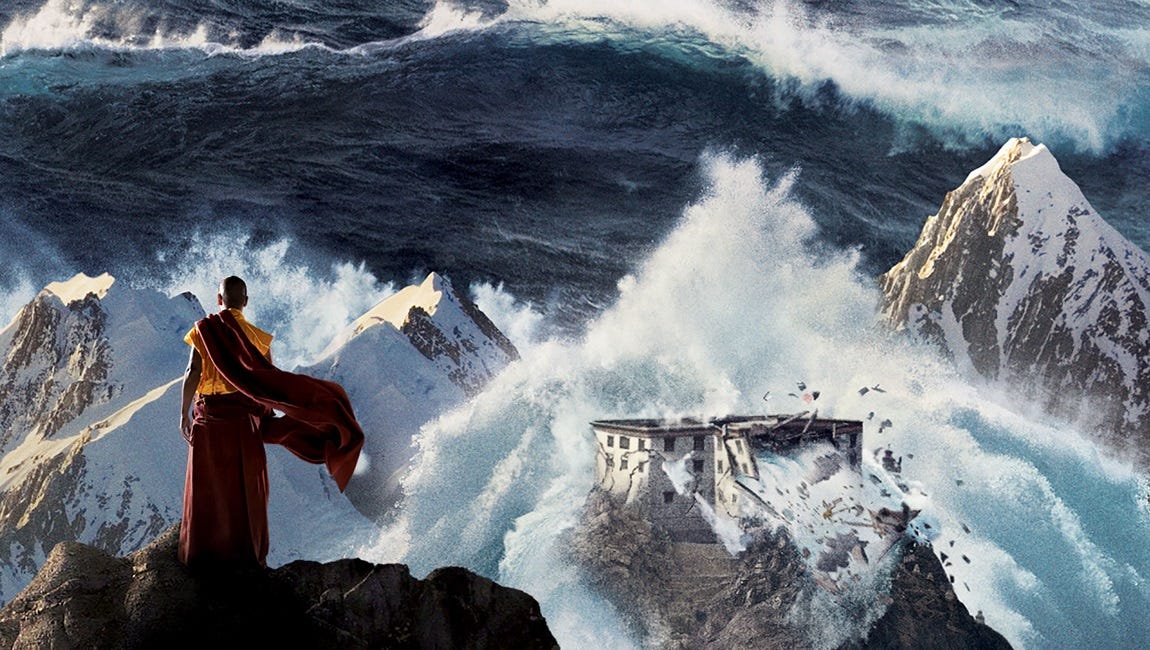
We share our planet with animals, plants, bacteria, and whatever other microscopic atom you can think of. When we take a step back and think about all of these things—innocent and simply existing—being erased… suddenly it makes these films a lot more unsettling.
With humans, it’s a bit different. Some of us are evil. Some of us are terrible and rotten. We have morality rooted within our minds, but animals don’t share the same concepts. They simply exist, living out their lives instinctively.
Humans dying is one thing—still horrible and tragic—but animals dying is another. To have species wiped out over something so catastrophic, it’s hard to swallow. Same with imagining our history, cities, and beautiful landscapes being gone in a split second.
What both The Day After Tomorrow and 2012 do is not just show us the scale of mass destruction, but show us that nature doesn’t need us. Humans may need nature, but nature can get along just fine without us ruining its vibes.
In The Day After Tomorrow, we’re the reason for our own doom. Our pollution and neglect cause the planet to turn against us. But in 2012, it isn’t about what we caused… it’s about how we reacted. Humanity fails to come together, resulting in us destroying each other simply out of selfishness.
While the giant storms grab audiences’ attention, the messages of these films reveal something much darker: the world collapsing isn’t scary because of the collapse, it’s scary because we’d be forced to watch beauty, history, and all hope disappear with it.
The End of Creativity
What’s the old cheesy quote that every artist has said was “deep” at least once in their life? Oh, that’s right: “The world without art is just ‘eh.’”
One of my favorite variations of this line comes from Kendrick Lamar in his unreleased song “The Prayer”:
“I got a theory that most o'yall won't allow to see
It goes like this: talent doesn't choose morality
See, if Daniel Hale was a killer, would you not want a heart?
If Karl Benz was a racist, would you stop driving cars?
I can't help we jump in these bodies and you called them a god
Just know the earth is just a rock without the voices of art”
Once our voices are erased and our art is gone… our world will just be another rock floating in space.
A Quiet Place, for example, hammers the nail into the head. Art and self-expression are fatal in their world. Musicians can no longer express their thoughts into beautiful melodies, writers can no longer type away their stories, and artists can no longer scratch pencils against paper.
They aren’t just living in a world of silence… they’re living in a world of creative death.
Meanwhile, other films like Children of Men bring up another question: how do we continue to create art without meaning?
In Children of Men, humans are suffering from an infertility crisis. As the human species slowly dies out, the world is turned into a cold and authoritarian regime.
When there’s no hope in a future, what’s the point in expression? When there’s no children, where’s the true and unfiltered imagination?
Even further, I can bring in stories like Fahrenheit 451, where we see books being burned. It is literally the erasure of creative thought and individual thinking.
What’s the point of survival if there’s nothing left to say? While the world may keep turning, without the voices of creativity, who cares about some rock in space?
The Eradication of Emotion
What’s most unsettling about the sudden end of the world comes from within us. When the world ends, so does everything we created: our memories, our emotions, our families.
In some post-apocalyptic stories, our world ends not because of cataclysmic events, but because of our lack of compassion. Iconic novels like 1984 and The Giver, shows us worlds without identity or emotional thought.
The Giver, though known for its pristine utopian setting, showcases a world without emotion. There is no more pain or suffering because there is no more happiness or love. If there’s no sadness, there’s no devastation. But with everything being the same, what’s the point in living?
1984 takes a different approach, with the government having constant surveillance over its citizens. Big Brother watches over everybody, controlling their every move and thought. You cannot express love, and you certainly can’t express the truth. You are Big Brother. There is no you.
In other stories, we see that the disasters are what causes the human emotion to dwindle. In films like The Mist or 28 Days Later, the emotional soul of what makes us human disappear. Suddenly, it is only about survival and selfish desires.
The Mist offers religious fanatics who are quick to suggest sacrificing children. 28 Days Later gives us survivors forced into sex slavery.
It doesn’t matter the situation… human connection is thrown out the window once someone becomes threatened.
And yet, we also are given movies like Knock at the Cabin and Don’t Look Up.
Knock at the Cabin explores the end of the world in a different way. A family—Andrew, Eric, and their daughter, Wen—is on vacation in a remote cabin, when suddenly four strangers invade their home. The strangers inform the family that one of the three will have to sacrifice themselves to prevent the end of the world.
As the time counts down, extreme events begin to cause tragedy all over earth: infections spread, natural disasters strike, and fires burn. Each stranger, who are likened to the Four Horsemen of the Apocalypse, must sacrifice themselves until the family finally decides on who to must die.
But it’s not until the end of the film where the emotional core finally cracks: Eric chooses to sacrifice himself. Although a brutal act, he’d rather die in peace knowing his family is safe rather than watch the world burn.
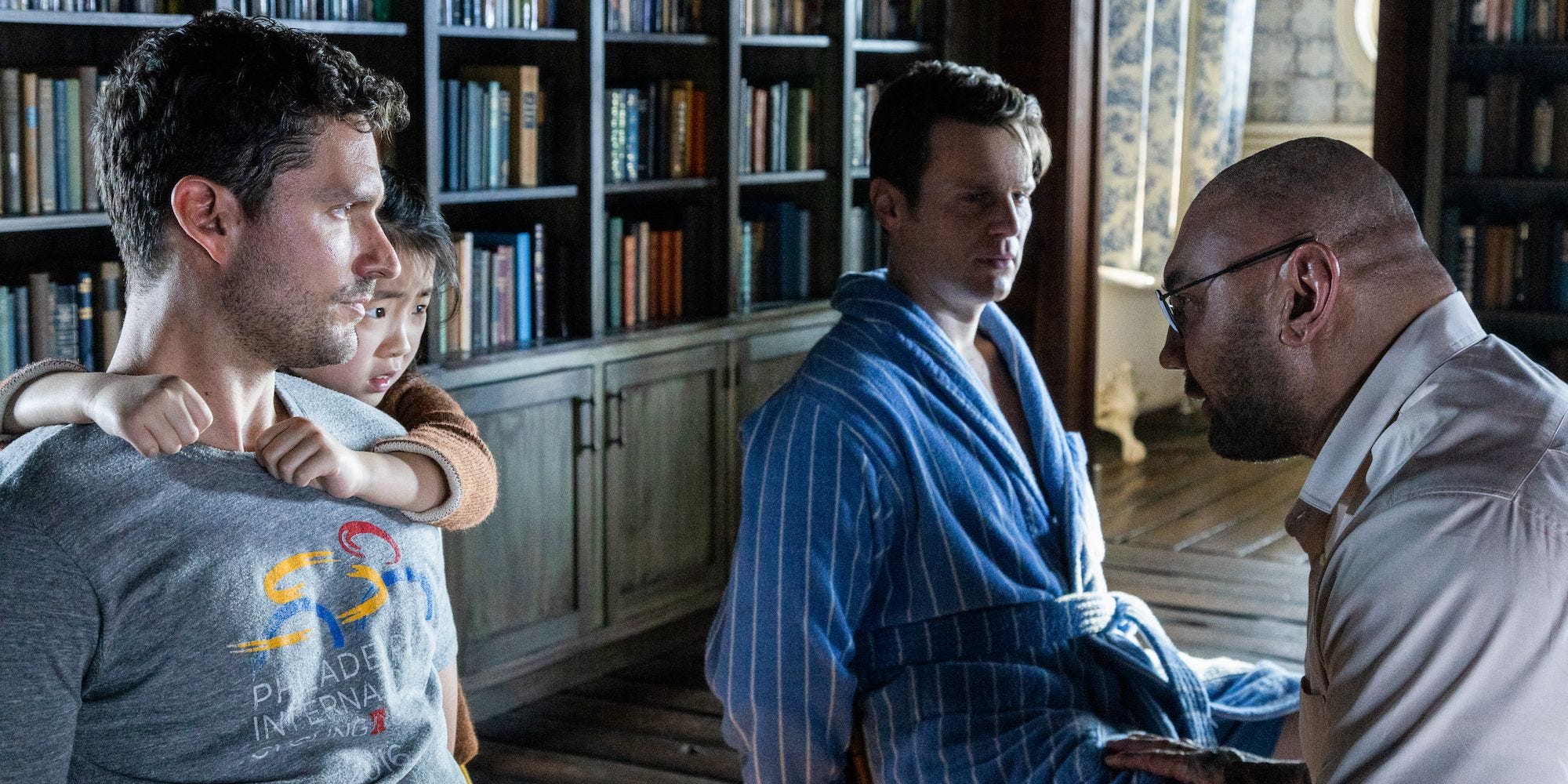
It’s a devastating scene, full of tender love despite the tragic outcome. While the world survives because of Eric, there’s one less caring soul on earth.
It’s a film about letting go, and in Don’t Look Up, the emotional gut punch takes a different form.
Don’t Look Up takes all of these aspects into account. It shows us the end of nature, the end of art, and the end of humanity all at once.
The animals are thriving. Nature is full of beauty. People stare as the asteroid approaches.
The characters of the film spend their final moments together at dinner, sharing stories and laughter for one last time. Despite knowing everything will be gone—including their lives—they’re able to hold onto the only thing that matters… human connection.
Even with all hope being lost, they still have love.
These films don’t just show us the end of the world, they show us what we lose in the destruction. Our empathy, our connection, and our humanity all disappear from the universe.
Maybe that’s what makes the end so unbearable for us all. We’re forced to reflect on everything we have. And in the same moment, we’re forced to let it go.
Apocalypse movies aren’t always horror movies, but there’s always something terrifying about them. Even if some of us feel desensitized about these types of films, there’s still the underlying dread of what it means to fully see the end of everything.
If our planet exploded tomorrow, did you do anything worthwhile? Did you chase your dreams? Did you find your passion? Did you have love? While we may not be fully erased in spirit, any physical evidence of what we were or what we created would be gone.
If our planet fell to devastation and the human species went extinct, what would you want the aliens to find in their archeological findings? That may sound silly but really think about it. Do you want them to find your makeup collection, or that typewriter you felt connected to? The one you wrote on every day until the end came.
Will they find your oil paintings? The portraits you made of the different people in your life.
Will they find your old recordings? The songs you created full of passion.
We don’t know when the world will end. That can be scary in itself, sure… but isn’t scarier to think our humanity can be erased?
As DiCaprio’s character says at the end of Don’t Look Up: “We really did have everything, didn't we?”
Children of Men is a great movie. One of my favorites on this list.