

The Popular Kids Are Hiding Something
How high school horror dissects cliques and teen culture


What does it mean to be the popular kid?
What emotions come from being at the top of the hierarchy at high school? Does it bring joy? Does it bring envy? Does it bring fury?
Cliques are the stereotypical jocks and mean girls we see in media. They expand from popular girls to goth kids, to jocks to nerds, to outcasts to stoners. If you are living through the high school experience, you have to face the reality of the disillusion of community.
You may feel like you need the validation from peers — the need to fit in, the need to be liked, the need to be something more than just another kid in the hallway.
For me, high school was whatever. I knew it wasn’t my days of glory, nor did I care about peaking in my teenage years. But the concept of conformity is not missed on me, considering the need to blend into the crowd seemed not just easier to do, but vital for survival.
That’s a trend with high school, isn’t?

Conformity is Trendy
In the age of social media, conformity has become the trend.
Apps like Instagram and TikTok have conditioned young minds into what they should look like, should listen to, should watch, and should even think.
At some point, the question isn’t “How do I fit in?” It’s “What does it mean to be yourself?”
The 80s tackled this question in the cult classic film Heathers, presenting us with the archetype of high school hierarchy through the titular group of Heathers. The Heathers, a group of girls all baring the same name, dress in color coordinated power suits to show their authority in their school.
While the group consists only of Heathers, there’s one member who stands out from the rest: Veronica Sawyer. She’s the odd one out, trying to fit in despite her namesake. Her goal is to be popular and stay in the graces of her peers, yet that meant abandoning her roots.
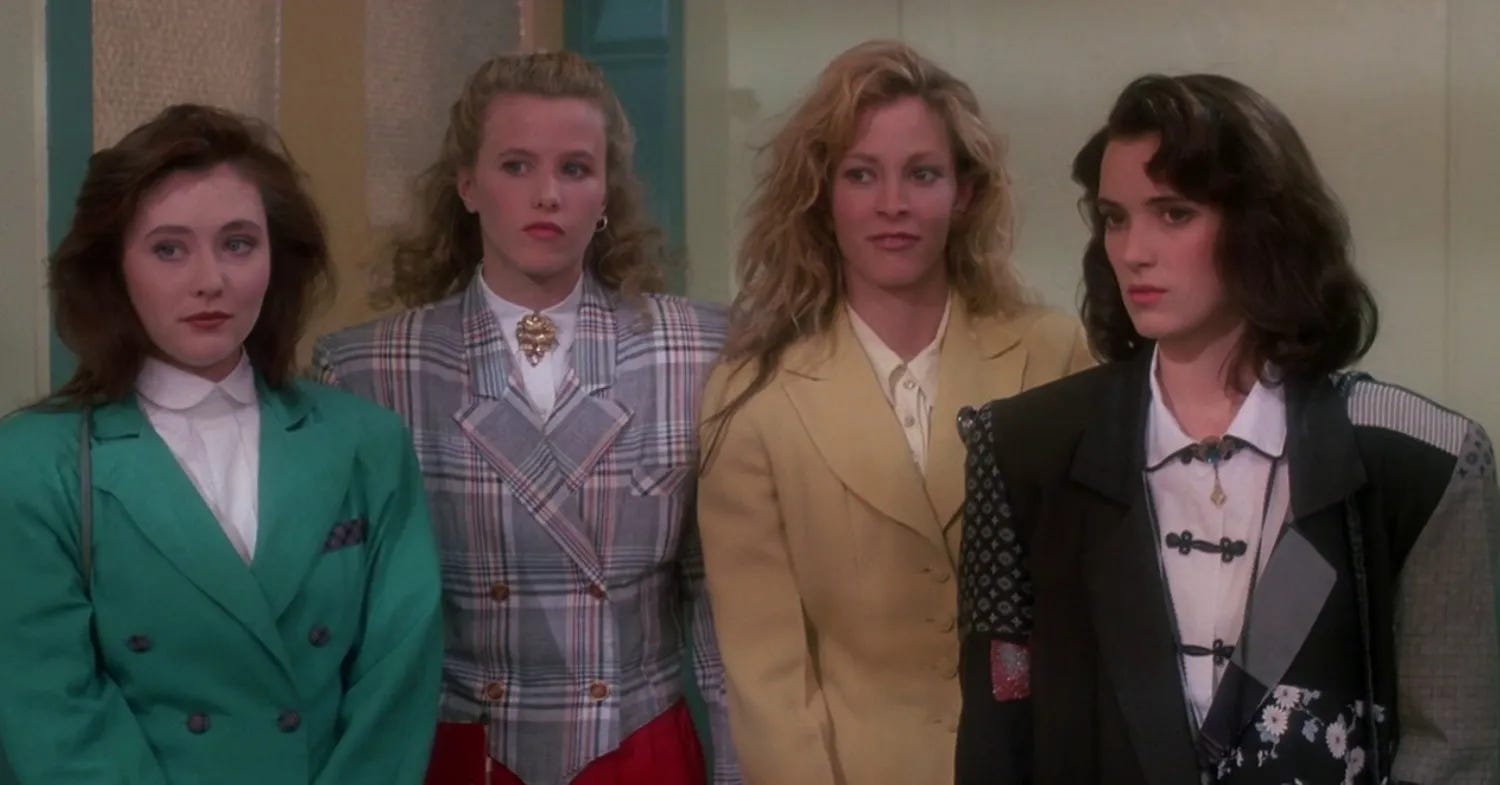
When the new kid rolls into town, the Heathers are met with a challenge: Jason Dean. JD isn’t necessarily there to make friends, but rather to disrupt the faux authority that infests the school. He’s there to take out the “popular kids” and create a society free of hate.
In particular, we see where he’s coming from with this quote: “Pretend I did blow up the school. All the schools. Now that you're dead, what are you gonna do with your life?”
There’s a fine line between the idea of being carefree and the idea of being careless. A carefree person doesn’t care what anybody thinks. A careless person is so lost, that they don’t care what happens next.
JD is a complex character in this sense. He’s both careless yet carefree. He’s so bent on correcting the societal hierarchy, that he doesn’t even begin to think about the why. Or… he does, but not in the rational sense.

One of the darker scenes of the film sees JD being confronted by Veronica before he tries to kill another student. In his hand he holds a knife, dirty and otherwise lackluster, as he speaks to her about the ordeal.
Veronica insists that the knife is too filthy for Heather Duke to ever use in a suicide, prompting JD to force her to look at her own reflection in the blade.
“Tomorrow, somebody else is just going to move into her place. That person could be me,” she says, but not before reminding him that she’s the only person who knows how to copy people’s handwriting. In response to this, JD says:
“You don't get it, do you? Society nods its head at any horror the American teenager can think upon itself. Nobody is going to care about exact handwriting.”
The teenage experience is summed up into one big freak show for the world to see. There is no reason to fit in or to be an individual, because nobody really cares until it’s too late anyway. Perhaps, then, Heathers is making a point more so about how the stripping of individual expression causes more harm than good on the youth due to outside factors rather than the cliques within high schools.
“Society,” as JD said, doesn’t pay attention to the safety of their youth until they are faced with the harsh realities. It isn’t until people get hurt that media begins to rally behind the students and advocating for young folks to be more forgiving of themselves.
It isn’t, then, an issue until the problem releases itself from its invisibility. The dam that society placed upon the teenage horrors break, and there is suddenly a flood that threatens to drown the entire city.
Heathers focuses on every aspect of the teenage experience: cliques, outcasts, broken homes, bullying. It’s all there for us to see and laugh at while watching a teenage boy murder students in his own fucked up vigilante way.
So, now that you’re dead, what are you going to with you life?
Popularity Means Nothing When You’re Dead
What happens when you finally conform to their standards and become one of them?
You finally did it: you’re at the top of the food chain. You’re a somebody in a sea of nobodies, but a nobody outside of high school. Still, you’re a somebody in that building, if only from the hours of 7am to 2pm, and that means something.
But what does it get you? What special awards do you obtain? What silly accolades do you gain from walking down the hallway only for everybody to either gawk at you and or whisper about you?
Enter Jennifer Check, the most popular girl in her school, acting as the pretty face of the color guard team while flashing smiles at the student body.

Although Jennifer’s Body sinks its teeth into mean girl culture, it also takes a step back to reveal the evils in the abusive powers at be. Jennifer isn’t just another popular mean girl—she’s a victim of circumstance. Her cannibalism isn’t from the desire of flesh, but rather the result of a cruel ritual gone wrong.
Low Shoulder, the fictional band in the film, lures Jennifer into a trap. Thinking she’s a virgin, they perform a sacrifice to Satan in order to gain fame and notoriety.
Jennifer is simply used. She is a tool for their own wants, and Jennifer’s safety and spirit is ripped away all for their own desires. Clearly, there’s bigger metaphors presented through this scene, and we can go on and on about the dangers of not only Hollywood, but the predators that lurk upon those still learning and developing… but that’s neither here nor there.
After the ritual is performed, Jennifer’s lack of virginity morphs her into a succubus, feasting on human flesh and souls. She is forced into a monster not because she wanted to be one, but because of how she was perceived. Yet, her need for blood becomes more and more involved, murdering several boys in her class while keeping up appearances.
“Hell is a teenage girl.”

So what does it mean to be popular? Does it really matter when you’re dead and gone from this world? Did those four years of high school really matter in terms of how “cool” you were?
When the soul leaves this plane of existence, what did you really do it all for? To be popular? To peak in high school? To be famous and harm people to get there?
Was any of it worth it? Were you truly happy?
Because at the end of the day, wasn’t Jennifer finally freed of her prison when she was killed?
Ego and Class
Prom Night (1980) is a slasher film, focusing on the popularity contest that comes with prom.
An age old tradition seen commonly in American high schools, prom night is meant to serve as a community gathering for the student body to celebrate. However, this celebration can be cut short due to the infamous king/queen vote, where students are put against each other in a pseudo hierarchy.
The competitive aspect of this event is taken to the extremes with Prom Night, as students are brutally killed one-by-one by a masked assailant.

Prom Night represents the pressures of the competitive nature in such school events. The prom queen and king are seen as the “it” couple, creating a culture of one-upping one another in order to be seen.
But it’s the lavish nature of prom’s faux promises that truly make this film shine. The murders in this film can be seen as representative of friendly competition gone wrong, with everybody wanting to be crowned the royalty of the school. Prom Night dresses trauma and vengeance up in sparkly dresses and tiaras, refusing to let the viewer see the truth.
The reality, however, is that there’s a very real and tragic reason behind all the kills: the victims in this film were responsible for the killer’s sister’s death.
Although Prom Night is seen as another 80s slasher movie, it does dig into the fears many teens face when attending prom. The battleground of the status quo, fighting for popularity and ego points. The prom game isn’t just cruel when you fight for attention; it’s deadly.
But it isn’t just prom that you have to worry about: it’s the entire high school experience.
In Disturbing Behavior, we see a new type of clique: polished, preppy, over-achievers. Called “The Blue Ribbons,” the group acts as the solution to high school’s version of perfection.
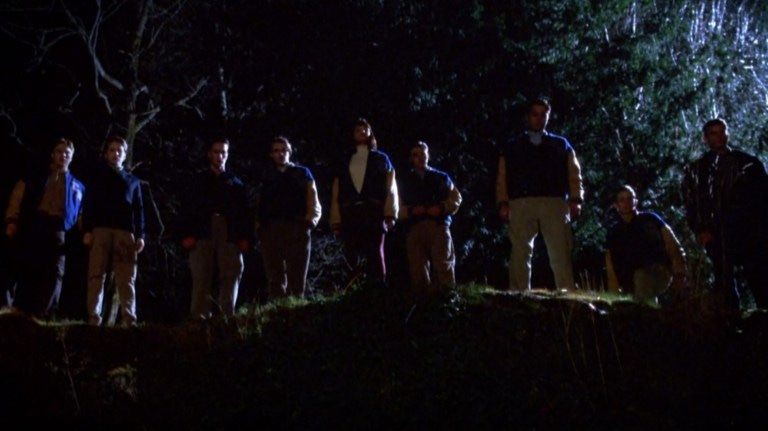
In the film, they’re warned to be a murderous cult that have been brainwashed by the school psychologist. As the movie goes on, we see members of The Blue Ribbons have bouts of rage whenever they’re presented with any type of sexual arousal.
It isn’t until later that we find out the school psychologist was in fact brainwashing students, though through neurological microchips meant to reprogram their behavior from delinquent to model citizen.
In this case, the parents agreed to have their children be brainwashed. It’s the parents’ egos that fuel the horror of this, unable to let their children become their own person. Instead, there’s a need for perfectionism. There’s no need for acting out and self discovery if you’re already perfect… and after all, doesn’t everybody want to be perfect?
But the microchips didn’t account for the human’s naturally occuring hormones, causing the fits of anger when the students became aroused. Their sensuality become fury, unable to control their feelings, simply because they don’t know how.
These teenagers are being ripped away of vital development. Their risks vs reward sectors are screwed. Their learning curves about relationships are gone. And instead, they’re simply living without actually being there.
Why can’t you let them learn naturally?
High school popularity is a human construct. Just like any popularity it is.
But we humans like to make life harder on ourselves. There’s not really a reason why… or at least I don’t think so. Maybe it’s just our ego fighting the peace, disrupting the ripple in time we have.
In high school, that ego is weaponized more than ever. Who’s the popular girl? Is he the captain of the football team? Is he seriously the class clown? Did you hear about Jack and Diane?
There’s a long list of things you care about when you’re a teenager. Typically, that includes your grades, maybe a sport or a club or an elective… but there was always that sense of worrying how you looked.
How did people perceive you? How did people look at you?
While we lowered our heads and avoided the hallway crowd, the popular kids walked with their heads held high. But how many of them were happy?
How many people in high school were actually happy? How many were fighting demons? How many just tried to get through the day?
Zooming out, your perspective on the high school experience changes a lot when you mature. You realize there’s a lot more to life than trying to fit in and be cool.
But that’s something the youth has to learn on their own… and they have some help with that. They can turn on any horror movie when they need it.
I loved watching Heathers when I was a teenager.